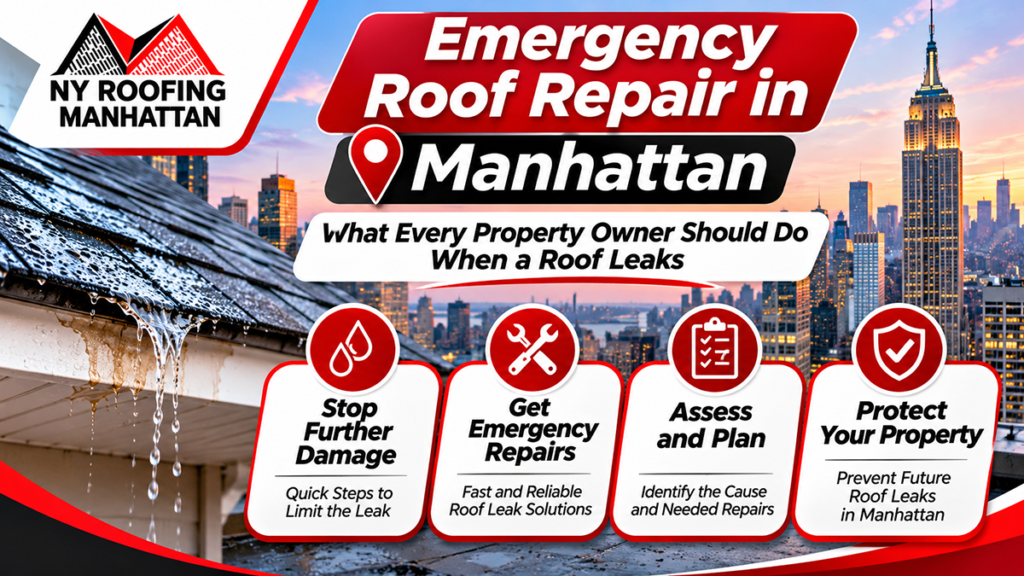
Quick Answer: A Manhattan roof leak needs immediate interior protection, clear documentation, and safe roof assessment before permanent work begins. Flat roofs, parapets, rooftop equipment, high-rise access, landmark status, and occupied spaces all shape the emergency response.
What Counts as a Roofing Emergency in Manhattan
A roofing emergency begins when active water entry, loose exterior material, structural movement, or an open roof creates an immediate risk to people, interiors, equipment, or the building envelope. Water above electrical fixtures, a ceiling bulge, displaced parapet coping, branch impact, or membrane damage that leaves occupied space exposed all require fast action.
Manhattan properties raise the stakes because one roof often protects many occupants or businesses. An Upper West Side co-op leak reaches apartments, plaster ceilings, elevator areas, or mechanical spaces. A Midtown commercial leak affects offices, equipment, retail space, or tenant operations. SoHo and Tribeca loft roofs often contain skylights, decks, ducts, and rooftop equipment, while Harlem and Hamilton Heights townhouses add parapets, party walls, roof hatches, and rear low-slope sections.
The first goal is stabilization. Protect people, limit additional water entry, document the condition, and establish safe access for professional repair.
What to Do in the First Hour of a Roof Leak
Keep people away from water near electrical fixtures, wiring, sagging ceiling materials, or unstable finishes. Move furniture, electronics, documents, inventory, and other valuables only when the area remains safe. Place containers under active drips where practical and protect nearby surfaces without entering an unsafe ceiling or roof area.
A bulging ceiling signals trapped water and weakened material overhead. Close off the affected area rather than puncturing it or standing beneath it. Wet, icy, high, or unfamiliar roofs also remain off-limits during an emergency.
Photograph the interior damage, note when the leak started, record the weather conditions, and document exterior damage visible from a safe location. Co-op boards, condo managers, landlords, and commercial owners also benefit from recording the affected unit, floor, ceiling location, and corresponding roof zone once access becomes available.
| Immediate Condition | First Property-Owner Action | Roofing Follow-Up |
| Water near electrical fixtures | Keep people clear | Urgent roof and electrical assessment |
| Bulging or falling ceiling finish | Close off the area | Trace water source and inspect assembly |
| Active flat-roof leak | Protect interior contents | Check drains, seams, parapets, penetrations |
| Storm-created opening | Keep occupants away from exposure | Temporary professional weather protection |
| Loose parapet or coping above sidewalk | Protect the area below | Stabilization plus masonry and roof work |
| Leak near rooftop equipment | Notify building management | Inspect curb, flashing, membrane, drainage |
In a co-op or condo, notify the superintendent, managing agent, or board contact immediately because roof access and common building systems usually fall under building control. Confirm roof-hatch keys, elevator access, loading arrangements, and building contacts before the roofer arrives.
Why Manhattan Building Type Changes the Emergency Response
A Manhattan roof emergency rarely follows one standard access route or repair process. Building height, occupancy, roof geometry, street conditions, and rooftop systems all affect how crews reach the problem and how the building protects occupied areas below.
| Manhattan Property Type | Common Emergency Leak Zone | Response Challenge |
| Upper West / Upper East Side pre-war co-op | Drains, parapets, bulkheads, skylights | Occupied apartments, shared systems, roof access |
| Harlem / Hamilton Heights townhouse | Parapets, party walls, rear low-slope roofs | Narrow access, adjoining buildings, masonry |
| SoHo / Tribeca loft or mixed-use building | Skylights, decks, equipment curbs, drains | Large roof areas, tenants, rooftop use |
| Midtown / Financial District high-rise | Mechanical zones, penthouse roofs, perimeter details | Height, staging, safety coordination |
| Chelsea / Greenwich Village historic property | Roof edge, cornice, terrace, flashing | Landmark review for permanent exterior work |
Pre-war co-ops often have low-slope roofs with several internal drains, bulkheads, skylights, elevator overruns, vents, and equipment zones. Water travels beneath membrane layers or along structural components before appearing inside. Property managers gain useful diagnostic information by mapping reported leaks against drains, parapets, penthouse walls, equipment curbs, skylights, and earlier roof repairs.
Townhouses in Harlem and Hamilton Heights often place the roof behind masonry parapets. Water reaches top-floor interiors through coping joints, party-wall transitions, chimney masonry, roof hatches, or rear extensions. In Midtown and the Financial District, the roof surface often has dense mechanical infrastructure, restricted access, and public areas below, which adds staging and safety requirements to the emergency response.
Emergency Leak Diagnosis on Flat Manhattan Roofs
Flat-roof emergencies often begin with drainage or perimeter transitions rather than a large opening in the membrane. Internal drains and scuppers collect runoff across broad roof areas, while parapets, equipment curbs, bulkheads, skylights, ducts, vents, and penthouse walls interrupt the waterproofing.
During intense rain, a partly blocked drain raises water around low penetrations and wall flashing. During a winter thaw, ice around a drain traps meltwater on the roof. Strong wind pushes rain against parapet faces, penthouse walls, and vertical flashing. The weather pattern often narrows the likely source.
Temporary emergency work focuses on stopping additional water entry without hiding the underlying failure. Localized protective covering, drain clearing, membrane stabilization, or flashing protection gives the building short-term protection until the roof dries and permanent work begins. The permanent scope then addresses the surrounding membrane, insulation, substrate, and water path.
DOB Rules for Emergency Roof Repair
NYC distinguishes ordinary non-structural roof repair from emergency work that normally requires a permit. DOB: Does my project require a permit? lists non-structural roof repair among permit-exempt work.
The same DOB guidance allows licensed contractors to perform emergency work before permit issuance when the condition requires work that otherwise falls under permitting rules. An Emergency Work Notification then gets filed within two business days after completion.
This distinction matters when opening the roof reveals more than a membrane defect. Structural deck failure, unstable framing, major parapet movement, or another hazardous condition changes the scope from routine leak repair into broader building work. Temporary stabilization addresses the immediate hazard, while the permanent repair follows the applicable filing path.
Roofing, electrical, plumbing, mechanical, and façade work also remain separate trades. Each part of the emergency needs the proper contractor and documentation.
Parapets, FISP, and Public Safety
Manhattan owners often manage both roof-edge leaks and exterior-safety responsibilities at the same time. NYC Building Parapet Observations requires annual observation of qualifying parapets that front the public right-of-way, regardless of building height, with stated exemptions. Owners retain the observation report for at least six years.
Many Manhattan buildings also fall under the DOB Façade Inspection Safety Program. FISP applies to buildings higher than six stories and requires periodic examination of exterior walls and appurtenances on a five-year cycle.
A roof leak near coping, a cornice, penthouse wall, or parapet often intersects with those exterior conditions. Loose coping, displaced masonry, or falling material creates a public-safety issue beyond water entry. The parapet guidance directs owners to call 911 when a building element is dangerous, collapsing, or creating an immediate falling-debris hazard.
Roof, masonry, façade, and public-protection work need coordination around the actual condition rather than separate repairs that leave one component unresolved.
Emergency Roof Work on Landmarked Manhattan Properties
Manhattan contains extensive historic districts and individual landmarks, including Greenwich Village, SoHo, Tribeca, Chelsea, Harlem, and sections of the Upper East and Upper West Sides. Landmark status creates an important difference between temporary emergency protection and permanent exterior work.
The LPC Emergency Repairs fact sheet identifies temporary tarps or protective coverings over holes in roofs or walls as emergency measures that do not require an LPC permit. Most permanent exterior repairs on designated properties still require the appropriate LPC approval.
LPC also directs owners dealing with an emergency at a landmarked property to contact the agency at 212-669-7817 or [email protected], with a preservationist assigned for guidance. Historic material dislodged during the emergency belongs on site for evaluation and repair rather than immediate disposal.
That process gives owners a practical path: protect the building first, preserve significant material, then prepare the permanent repair under the correct preservation review.
Permanent Repair After Emergency Stabilization
Emergency work is only the first stage. Once the roof is dry and safe, the contractor needs to establish why the failure occurred and whether hidden materials were affected. Wet insulation, deteriorated decking, open flashing, damaged coping, or failed equipment curbs require a permanent scope that restores the assembly instead of leaving temporary protection in place.
The repair method follows the roof system. EPDM, TPO, modified bitumen, built-up roofing, metal, slate, and shingles all use different materials and detailing. Drainage also needs correction when ponding or blocked outlets contributed to the leak. Unstable masonry gets repaired before final roof flashing ties into the wall.
Keep photographs of the original damage, temporary work, opened assembly, and completed permanent repair. Co-op boards and property managers also benefit from recording the roof zone, material, contractor scope, and repair date in the building maintenance file.
Preventing the Next Manhattan Roof Emergency
Prevention focuses on the details that interrupt waterproofing. Keep roof drains, scuppers, strainers, and overflow routes clear. Review parapet coping, wall flashing, equipment curbs, skylights, bulkheads, roof hatches, terrace transitions, and earlier repair areas during routine maintenance.
Mechanical service deserves particular attention on Manhattan roofs. HVAC technicians, elevator contractors, telecommunications crews, plumbers, and other trades regularly cross membranes and work around penetrations. Inspect the nearby roof after major rooftop service so punctures, displaced pads, loose flashing, or blocked drains do not remain unnoticed until the next storm.
For co-ops, condos, commercial properties, and large multifamily buildings, keep a simple roof plan showing drains, equipment, access points, and earlier leak zones. Fast access to that information improves emergency diagnosis and reduces repeated searching during active water entry.
Get Emergency Roof Repair From NY Roofing Manhattan
An emergency roof leak needs fast stabilization followed by a permanent repair that addresses the actual water path. NY Roofing Manhattan works with townhouses, co-ops, condos, pre-war apartment buildings, mixed-use properties, commercial buildings, and high-rise roofing conditions throughout Manhattan.
For emergency roof repair or a free estimate, call NY Roofing Manhattan at (212) 660-0557, or visit the office at 31 E 31st St, New York, NY 10016 to discuss the leak, temporary protection, and permanent repair plan for your property.
FAQs: Emergency Roof Repair in Manhattan
What is the first thing to do when a Manhattan roof starts leaking?
Keep people away from electrical hazards, sagging ceiling material, and unstable finishes. Protect movable contents from water, document the leak from safe locations, notify building management where applicable, and arrange professional roof assessment. Avoid wet, icy, or high roof surfaces during the storm.
Does emergency roof repair in Manhattan require a DOB permit?
NYC DOB lists non-structural roof repair among permit-exempt work. When an emergency condition involves work that normally requires a permit, licensed contractors perform the emergency work first and file an Emergency Work Notification within two business days after completion. Structural or broader alteration work follows the applicable filing path.
Why does a Manhattan flat roof leak during heavy rain?
Heavy rain often exposes restricted drains, blocked scuppers, low roof areas, failed parapet flashing, bulkhead details, or equipment curbs. As water rises above its normal drainage level, it reaches seams and transitions that stay dry during lighter rainfall. The repair needs both leak tracing and drainage review.
What happens when a roof leak affects several apartments?
Building management needs to record the affected units and compare their locations with roof drains, parapets, skylights, penthouse walls, equipment, and earlier repairs above. Water often travels through walls, shafts, insulation, or structural components, so several interior stains sometimes trace back to one roof defect.
What happens if a Manhattan roof leak involves loose parapet masonry?
Keep people away from the area below and treat falling material as a public-safety concern. Dangerous or collapsing building elements require emergency services. Roof and masonry teams then coordinate stabilization and permanent work, while applicable parapet observation or FISP responsibilities remain part of the building’s exterior-safety obligations.
Are temporary emergency roof coverings allowed on landmarked Manhattan buildings?
LPC guidance lists temporary tarps or protective coverings over holes in roofs as emergency measures that do not require an LPC permit. Permanent exterior repair on a designated property follows the appropriate LPC approval process after the immediate exposure has been stabilized.
How do Manhattan property owners reduce the risk of another emergency leak?
Keep drains and scuppers clear, maintain parapet coping and flashing, inspect equipment curbs and roof hatches, review previous repair areas, and check the roof after major rooftop service. Co-ops, condos, and commercial buildings also benefit from a roof plan showing drains, access points, equipment, and earlier leak zones.